


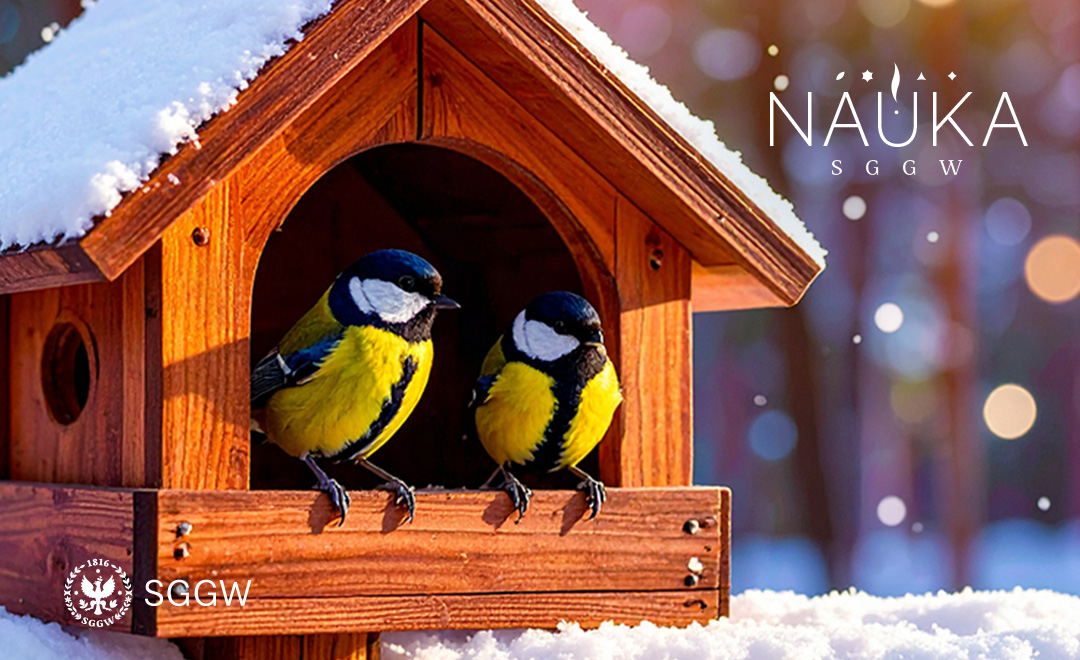
The first snowfall is behind us, which means we should pay special attention to avifauna. Dr. Arkadiusz Matuszewski, PhD Eng., from the Department of Environmental Biology of Animals at the Institute of Animal Sciences, Warsaw University of Life Sciences (SGGW), spoke about feeding birds in winter.
When to feed birds
In Poland, winter bird feeding is one of the most commonly practised forms of human contact with nature.
In spring, summer and autumn, as well as during mild winters, birds cope very well with obtaining natural food – their diet is then diverse and adapted to the seasonal needs of their bodies. In a temperate climate zone, bird feeding becomes justified only when access to natural food resources is limited, primarily during periods of prolonged frost and persistent snow cover. With the onset of winter, birds’ energy requirements increase significantly, as maintaining a constant body temperature at this time involves a high energy expenditure. An additional source of food can help birds maintain good physical condition during winter, which may translate into higher breeding success in the following season.
An important element of properly conducted winter feeding is its continuity. Birds learn relatively quickly where permanent food sources are located and incorporate them into their daily foraging strategies. Abruptly discontinuing feeding during periods of unfavourable weather conditions may lead to an increased risk of mortality due to hypothermia, as birds are forced to intensively search for new food resources while the availability of energy sources is severely limited. For this reason, once feeding has begun, it should be continued uninterrupted throughout the entire winter period.
Feeding should be discontinued only when environmental conditions improve permanently, allowing birds to forage effectively in their natural surroundings. This usually occurs in early spring, when temperatures remain above zero also at night, snow cover disappears, and the availability of food such as insects, buds and seeds increases.
What to Feed Birds in Winter
In winter, it is most important to provide high-energy food. In practice, oil-rich seeds such as sunflower seeds work best, as do grain mixtures, for example millet and oats, and animal fats, such as unsalted pork fat (only during frosts, as fats may become rancid at above-zero temperatures). Birds also readily feed on unsalted nuts and fruits such as apples, pears, rowan berries and dried fruit. Specialised winter seed mixes, fat blocks and fat balls, as well as peanut butters intended for wild birds, are also available on the market and can be purchased in pet shops or online stores. Birds can be fed both with ready-made products and homemade food. Homemade fat balls, prepared using suet or lard without salt and enriched with seeds and finely chopped nuts, are a safe and valuable form of winter food.
At the same time, birds should not be fed bread, whether fresh or dry, as it is poor in nutritional value, swells in the digestive tract and causes only a false feeling of satiety. In feeders, it also easily becomes mouldy. Salted, seasoned, fried and generally processed products – including kitchen leftovers – are also unsuitable, as they may have a harmful effect on birds’ health.
During winter, it is also worth remembering to provide birds with access to fresh water. A shallow drinking dish with regularly replenished, unfrozen water can be significant support for many species, especially during snowless but frosty winters.
Bird feeders and their placement
The proper placement of feeders plays an important role. A feeder should be placed or hung at a height that prevents access by predators, especially cats, in a visible yet sheltered location. It should be constructed in a way that protects food from precipitation. It is recommended to avoid placing feeders directly next to large glass surfaces in order to reduce the risk of birds colliding with windows. Good practice also includes maintaining proper hygiene – removing leftovers, droppings and mouldy food, and disinfecting the feeder. Scientific studies indicate that high bird density at feeders increases the risk of pathogen transmission; therefore, cleanliness is crucial for the health of birds visiting feeders.
Food preferences
The food preferences of different bird species result, among other factors, from the structure of their beaks, which are adapted to obtaining specific types of food. Tits (Paridae), both the great tit (Parus major) and the blue tit (Cyanistes caeruleus), most readily consume oil-rich seeds, especially sunflower seeds, as well as pork fat, unsalted nuts and suet mixed with seeds. The Eurasian nuthatch (Sitta europaea) shows similar preferences. Members of the finch family (Fringillidae), such as the European greenfinch (Chloris chloris), the Eurasian siskin (Spinus spinus) and the bullfinch (Pyrrhula pyrrhula), prefer oil-rich seeds and mixed grains. The house sparrow (Passer domesticus) and the tree sparrow (Passer montanus) show greater interest in cereal grains such as millet or oats, although they also readily eat sunflower seeds. In contrast, species such as the common blackbird (Turdus merula), the fieldfare (Turdus pilaris) and the Bohemian waxwing (Bombycilla garrulus), which base a significant part of their winter diet on fruit, readily consume apples, rowan berries and other soft fruits.
Feeding birds in urban and rural areas
Bird feeding differs between urban and rural environments. Studies indicate that cities have the highest number of feeders, and birds use them very intensively. In urban environments, feeding involves not only small species inhabiting gardens, parks and residential green spaces, but also waterbirds occurring on urban water bodies, such as the mallard (Anas platyrhynchos), the mute swan (Cygnus olor) and gulls (Larinae), as well as corvids (Corvidae) and feral pigeons (Columba livia forma urbana). A phenomenon often observed in urban bird feeding is unintentional feeding, which results from the availability of food leftovers and waste. These constitute an easily accessible but low-quality food source, particularly for pigeons and corvids.
In rural areas, the scale of feeding and birds’ use of feeders is generally smaller. This results, among other factors, from greater availability of natural food in agricultural landscapes, including post-harvest residues and seeds of wild plants. Feeders are visited by both species associated with buildings and farmsteads, and by species typical of open areas, such as the yellowhammer (Emberiza citrinella). Near tree stands and small forest complexes, forest species may also visit feeders.
Under Polish climatic conditions, seasonal feeding conducted during the harsh winter period remains the most justified approach. However, this does not mean that the role of humans in providing food resources for birds disappears outside winter. Home gardens are gaining increasing recognition and popularity; when properly designed and managed, they can constitute an important source of natural food throughout the year. Naturalistic gardens support high biodiversity, creating favourable conditions for birds, especially through the availability of invertebrates during the breeding season and seeds and fruits in autumn and winter. Such resources are provided primarily by native species of trees and shrubs, including rowan (Sorbus aucuparia), hawthorn (Crataegus monogyna), common dogwood (Cornus sanguinea), dog rose (Rosa canina) and guelder rose (Viburnum opulus), whose fruits persist on plants during the autumn–winter period. Plants providing seeds in late summer, autumn and winter can also play an important role, such as coneflower (Echinacea), rudbeckia (Rudbeckia) and numerous species of tufted grasses which, when left uncut, constitute a winter food source for some granivorous species. From this perspective, winter feeding can be treated as part of a broader strategy to support avifauna, in which creating bird-friendly garden spaces plays a key role.
Dr Arkadiusz Matuszewski, PhD Eng.
Department of Environmental Biology of Animals
Institute of Animal Sciences, Warsaw University of Life Sciences (SGGW)
References:
1. Robb, G. N., McDonald, R. A., Chamberlain, D. E., & Bearhop, S. (2008). Winter feeding of birds increases productivity in the subsequent breeding season.
2. Biology Letters, 4(3), 220–223.
3. Tryjanowski, P., Skórka, P., Sparks, T. H., Biaduń, W., Brauze, T., Hetmański, T., Martyka, R., Indykiewicz, P., Myczko, Ł., Kunysz, P., Kawa, P., Czyż, S., Polakowski, M., Tobółka, M., Kłys, G., Wuczyński, A., & Wysocki, D. (2015). Urban and rural habitats differ in number and type of bird feeders and in bird species consuming supplementary food. Environmental Science and Pollution Research, 22, 15097–15103.
4. Wilcoxen, T. E., Horn, D. J., Hogan, B. M., Hubble, C. N., Huber, S. J., Flamm, J., Knott, M., Lundstrom, L., Salik, F., Wassenhove, S. J., & Wrobel, E. R. (2015). Effects of bird-feeding activities on the health of wild birds. Conservation Physiology, 3(1), cov058.