

How Do Polish Universities Function Within Alliances? Euro-Illusion or Reality?
The conference summarised the implementation of the “Support for European Universities” program (WUE NAWA), under which 34 Polish higher education institutions received funding to advance internationalisation by strengthening their roles in European academic alliances. The event served as an opportunity to exchange experiences, showcase best practices, and reflect on existing achievements and future directions for the initiative’s development.
European Universities – Euro-Illusion or Reality?
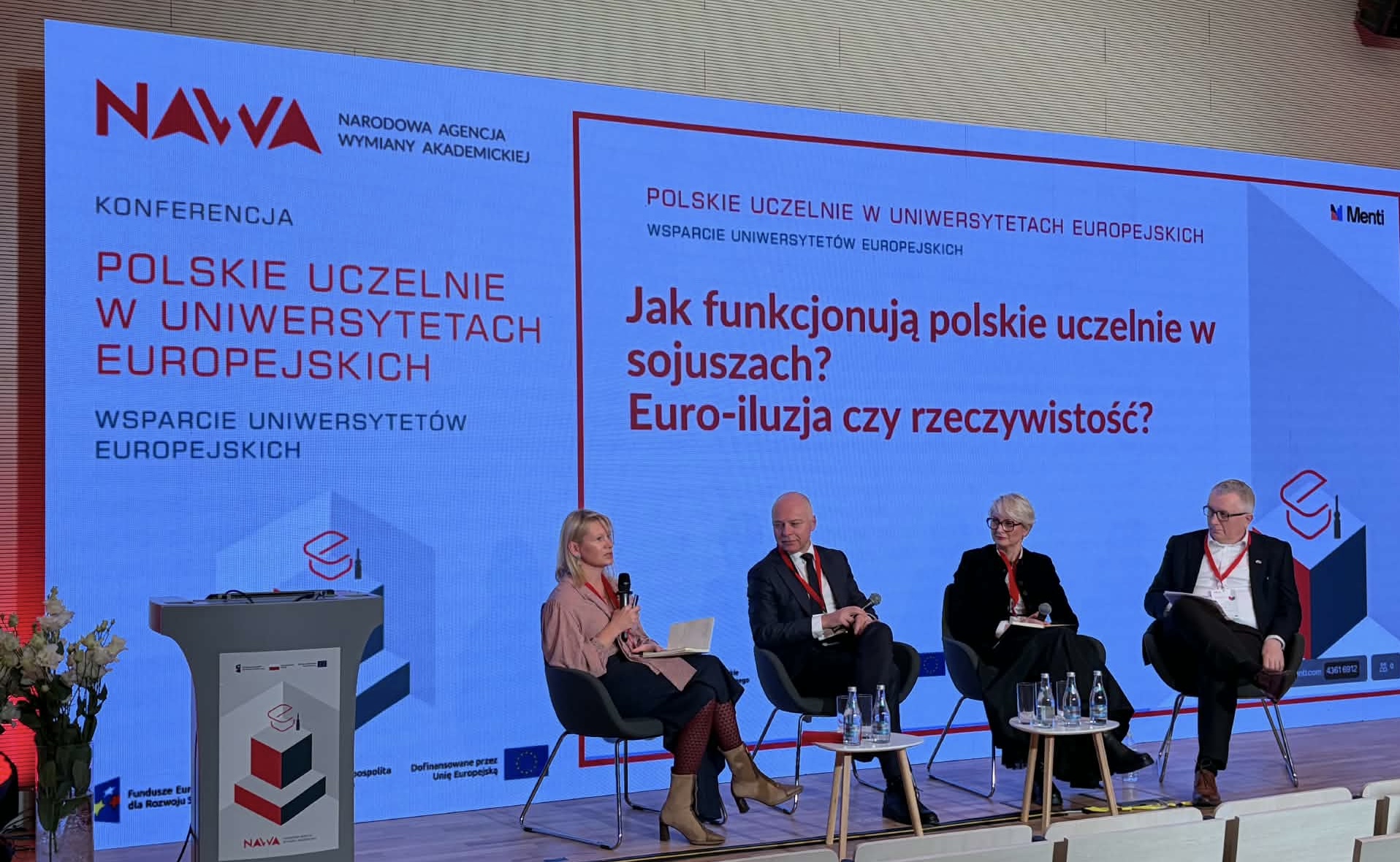
The panel discussion titled “How Do Polish Universities Function Within Alliances? Euro-Illusion or Reality?” was chaired by Prof. Marta Mendel, Vice-Rector for Internationalisation at SGGW.
The following panellists were invited to take part in the debate:
- Prof. dr hab. Mariusz Głąbowski, Vice-Rector for International Cooperation at the Poznań University of Technology;
- Prof. dr hab. Rafał Witkowski, Vice-Rector for International Cooperation at Adam Mickiewicz University in Poznań;
- Dr hab. Katarzyna de Lazari-Radek, prof. UŁ, Vice-Rector for Internationalisation of Science and Education at the University of Łódź.
Introducing participants to the topic, Prof. Marta Mendel highlighted the evolution in approaches to how European Universities operate—from the initial enthusiasm accompanying the creation of the alliances to a stage of mature, open, and critical reflection on institutional experiences. A willingness to discuss both successes and difficulties provides a vital starting point for taking further action and refining collaboration models. The moderator proposed examining the functioning of European Universities from three perspectives: the European Commission; university authorities and decision-makers; and independent scientific research, which enables an assessment of the actual level of organisational transformation within participating institutions.
Cooperation, Integration, and Sustainability of Results
A key element of the debate was audience engagement. Using the interactive tool Mentimeter, conference participants identified the greatest values of European Universities, as well as areas where they perceived discrepancies between the initiative’s assumptions and the realities of its implementation. Among the most important values were cooperation, integration, exchange of experiences, networking, breaking down barriers, and opportunities for professional development. Conversely, the greatest doubts concerned genuine solidarity and equality among partners, as well as the long-term sustainability of the achieved results. Comparing these responses became the starting point for a discussion on the conditions that must be met for European Universities to become a permanent element of university operations, extending beyond the timeframes and financial frameworks of individual projects.
From Project-Based Cooperation to Institutional Transformation
One of the central issues raised during the panel was the tangible transformation of the academic experience for both students and staff. Discussions covered, among other topics, access to partner universities’ educational offerings, the development of virtual campuses, the recognition of learning outcomes, and students’ involvement in the internationalisation process. The conversation also addressed the agency of project teams and their capacity to implement solutions developed within the alliances across the entire institution. Panellists emphasised the significance of diversity among partner universities, which—when properly leveraged—can serve as a source of complementarity, mutual learning, and growth. However, it can at times also create challenges in engaging everyone in the activities undertaken. They also underscored the role of academic diplomacy, negotiation skills, and consensus-building in managing complex international structures. Ensuring the sustainability of developed solutions and integrating them into universities’ day-to-day operations—even after project funding ends—remains one of the most pressing challenges.
SGGW Co-Creates the European Academic Area
The Warsaw University of Life Sciences (SGGW) participates in the European Universities initiative as a member of the UNIgreen – The Green European University alliance, which focuses on sustainable agriculture, green biotechnology, and environmental and life sciences. Membership in the alliance supports the development of international scientific and educational cooperation, the creation of new learning opportunities, academic mobility, and the exchange of knowledge and experience among partner institutions. SGGW’s involvement in the nationwide debate on the future of European Universities aligns with the university’s efforts toward internationalisation and co-creating a European Higher Education Area in which international cooperation becomes an integral part of how academic institutions operate.