


ESA 2026 at SGGW: Global Sociology Meets at the Nowoursynowska Campus
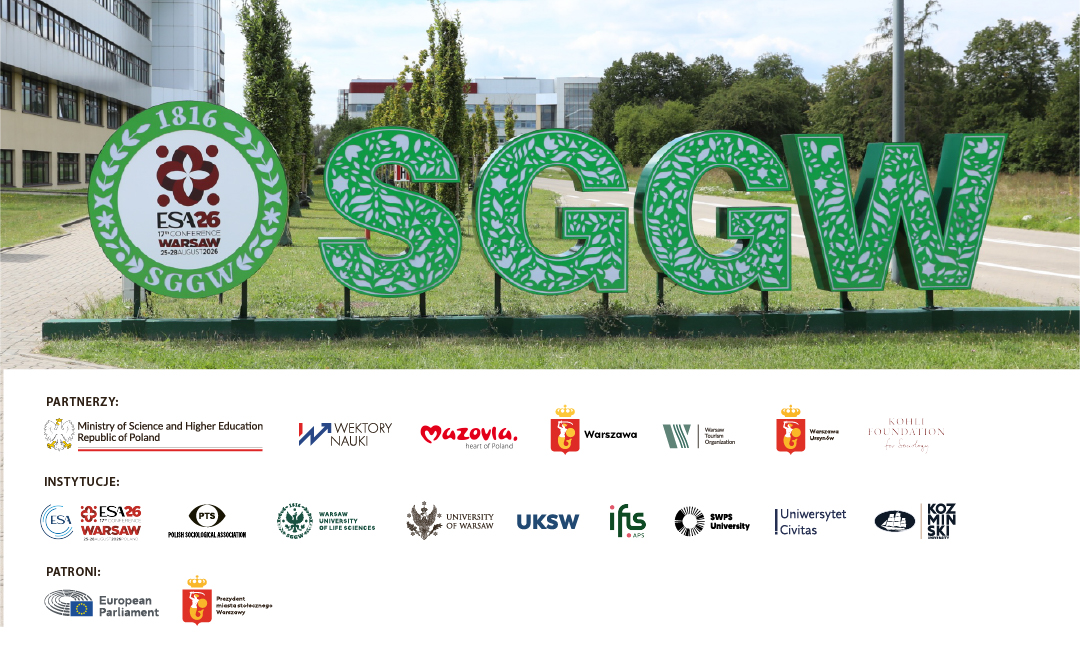
Nearly 4,000 social researchers from Europe and around the world will meet in Warsaw during the 17th Conference of the European Sociological Association (ESA). The Warsaw University of Life Sciences (SGGW), alongside the University of Warsaw, is one of the hosts of one of Europe’s largest events dedicated to sociology and the social sciences. On 26 and 27 August, the SGGW campus will become the main venue for the conference’s academic programme.
Nearly 4,000 social researchers from Europe and around the world will meet in Warsaw during the 17th Conference of the European Sociological Association (ESA). The Warsaw University of Life Sciences (SGGW), alongside the University of Warsaw, is one of the hosts of one of Europe’s largest events dedicated to sociology and the social sciences. On 26 and 27 August, the SGGW campus will become the main venue for the conference’s academic programme.
The 17th Conference of the European Sociological Association will take place in Warsaw on 25–28 August 2026, under the theme “Strengthening Democracies: Social Action, Solidarity, and Sustainable Futures.” More than 3,800 submissions were received for the conference, and thousands of papers will be presented within 42 ESA Research Networks, joint sessions, and other academic formats.
The conference programme reflects the key challenges facing contemporary societies. Discussions will cover, among other topics, democracy and political participation, inequalities, migration and borders, climate change, work and care, education, health, urban transformations, new technologies, and artificial intelligence.
SGGW as a Venue for European Sociological Debate
The conference will begin on 25 August with the official opening ceremony and the first plenary session at COS Torwar. Over the following two days, 26 and 27 August, the main academic programme will be held at the campus of the Warsaw University of Life Sciences (SGGW), 166 Nowoursynowska Street. On the final day, 28 August, the sessions will move to the University of Warsaw.
SGGW will host numerous sessions, research presentations, and discussions involving members of the international sociological community. The university’s role, however, extends beyond providing facilities for the conference. SGGW researchers are contributing to the conference both organizationally and academically, taking part in the work of the Local Organising Committee and presenting the results of their own research in the ESA academic programme.
ESA at the SGGW Campus – Science, Tradition, and Academic Identity
The ESA conference is being held in Warsaw for the first time and in Poland for the second time, following the conference held in Toruń in 2005. The organisers of the Warsaw event are the European Sociological Association, the University of Warsaw, and the Warsaw University of Life Sciences (SGGW).
The two days of the conference taking place at SGGW will also provide international participants with an opportunity to discover the university, its campus, academic community, and traditions.
One of the highlights of the programme will be a concert by the PROMNI Folk Art Ensemble. The performance will introduce conference participants to Polish folk culture while also reflecting SGGW’s historical links with the Polish countryside. PROMNI’s presence in the programme will offer international guests an opportunity to experience one of the distinctive elements of the university’s academic identity – one that combines contemporary science with cultural tradition and heritage.
17th Conference of the European Sociological Association
25–28 August 2026, Warsaw
26–27 August 2026 – main academic programme at the SGGW campus, 166 Nowoursynowska Street
SGGW Researchers in the Programme of the 17th ESA Conference
The following researchers from the Warsaw University of Life Sciences will present their research as part of the conference’s academic programme:
- Rafał Boguszewski – “Determinants and Consequences of Poles’ Withdrawal from Religious Practice in the Context of the COVID-19 Pandemic”, session “Changes of Religious Belonging and Constellations of Religious Actors.” Rafał Boguszewski will also chair this session as session chair.
- Konrad Burdyka – “The Rural Shield: Traditional NGOs at the Frontline of Social Resilience in Poland”, session “Institutions and Rural Futures.”
- Jolanta Grotowska-Leder – “Declining Fertility as a Result of Post-modern Risks and the Creation of New Threats in Key Spheres of Individual and Social Life. The Case of Poland”, session “Everyday Risk, Social Change and Life Trajectories.”
- Małgorzata Herudzińska – “Determinants and Consequences of Poles’ Withdrawal from Religious Practice in the Context of the COVID-19 Pandemic”, session “Changes of Religious Belonging and Constellations of Religious Actors.”
- Agnieszka Kampka – “Communication Practices in Democracy – Participation in the City”, session “Practices of Urban Engagements.”
- Wojciech Połeć – “Problems of Renaissance and Institutionalization of the Ethnic Belief System in Contemporary Societies. The Case of Buryat Shamanism”, session “Transformations of Religious Institutions.”
- Urszula Soler – “Human–Machine Collaboration in Trustworthy Biometrics: Social Dimensions of Technological Supervision”, session “Trust, Ethics and Human-AI Relations.”
- Bartosz Łukaszewski – “Polish Youth in the Algorithmic, Multidimensional and Multipolar World – Anxiety, Subjective General Health, Development Opportunities”, session “Children and Youth in Transformation: Methodological and Contextual Challenges.”
- Michał Wujek – “From Education to Employment: A Psychocybernetic Model of University–Socio-Economic Cooperation”, session “Crises.”
- Joanna Wyleżałek – “From Education to Employment: A Psychocybernetic Model of University–Socio-Economic Cooperation”, session “Crises.”
SGGW Doctoral Researchers
- Dominika Dziurosz-Serafinowicz – “Where Does a Lie Lie?”, session “(Non)understanding in Interaction.”
- Wiktoria Ługowska – “Conscious Creators or Passive Users? A Systematic Literature Review on Youth Digital Literacy in the Process of Building Peer Relationships”, session “Youth, Peer Relationships and Social Cohesion.”