

More than 3,200 social scientists from 68 countries across Europe and around the world will meet in Warsaw for the 17th Conference of the European Sociological Association (ESA).
The Warsaw University of Life Sciences – SGGW, alongside the University of Warsaw, is hosting one of Europe’s largest events dedicated to sociology and the social sciences. On 26 and 27 August 2026, the SGGW campus will become the main venue for the conference’s scientific programme.
The 17th Conference of the European Sociological Association will take place in Warsaw from 25 to 28 August 2026 under the theme “Strengthening Democracies: Social Action, Solidarity, and Sustainable Futures.” More than 3,200 submissions were received for the conference, with thousands of papers to be presented across 42 ESA Research Networks, joint sessions, and other academic formats.
The conference programme reflects the most pressing challenges facing contemporary societies. Discussions will address, among other topics, democracy and political participation, inequalities, migration and borders, climate change, work and care, education, health, urban transformations, new technologies, and artificial intelligence.
SGGW as a Venue for European Sociological Debate
The conference will open on 25 August with an official opening ceremony and the first plenary session at COS Torwar. Over the following two days – 26 and 27 August – the main scientific programme will take place at the Warsaw University of Life Sciences – SGGW campus at 166 Nowoursynowska Street. On the final day, 28 August, the conference will move to the University of Warsaw.
SGGW will host numerous sessions, research presentations, and discussions involving members of the international sociological community. However, the University’s role extends beyond providing a venue for the conference. SGGW researchers are actively contributing to the event by participating in the work of the Local Organising Committee and presenting the results of their research as part of the ESA scientific programme.
One of the Vice-Chairs of the Local Organising Committee is Dr hab. Joanna Wyleżałek, Professor at SGGW, Director of the Institute of Sociological Sciences and Pedagogy. Other SGGW representatives involved in the Committee include Dr hab. Urszula Soler, Dr hab. Agnieszka Kampka, Professor at SGGW, Dr Wojciech Połeć, Dr Rafał Boguszewski, Dr Konrad Burdyka, and Dr Małgorzata Herudzińska.
“This is a unique event for SGGW. For two days, our University’s campus will become a place of intensive debate among several thousand social scientists. It was important to us that SGGW should be an active participant in this gathering. Our researchers are involved both in its organisation and in international academic exchange. It is also an excellent opportunity to demonstrate that the social sciences have a strong tradition at SGGW while, at the same time, addressing highly contemporary questions concerning social change, democracy, solidarity, and sustainable development,” says Dr hab. Joanna Wyleżałek, Professor at SGGW, Vice-Chair of the Local Organising Committee of the 17th ESA Conference.
From Władysław Grabski to Contemporary Sociology
The presence of one of Europe’s most important sociological events on the SGGW campus also has a historical dimension. Sociology has been part of the University’s academic tradition for almost a century. One of the key figures in its development was Władysław Grabski – an economist, sociologist, two-time Prime Minister of Poland, and Rector of SGGW from 1926 to 1928. He initiated the establishment of the Institute of Rural Sociology. Through his pioneering research into social structures, living conditions, and transformations taking place in the Polish countryside, he is now regarded as one of the founders – and often as the father – of Polish rural sociology.
This tradition is echoed by Rector of SGGW, Professor Michał Zasada, who emphasises that the University’s longstanding interest in social change remains highly relevant to the challenges of the 21st century.
“Almost a century ago, Władysław Grabski, Rector of SGGW and one of the founders of Polish rural sociology, demonstrated that in order to understand the economy and the changes taking place around us, we must first understand society. This idea remains highly relevant today. That is why I am pleased that SGGW is becoming a venue for international debate on democracy, climate, migration, technology, and other challenges shaping the future of our societies. Every major change – technological, economic, climatic, or political – is ultimately also a social change. It is people who give it meaning, experience its consequences, and determine the direction in which it takes us. Hosting the ESA conference is therefore both a continuation of the University’s tradition and a confirmation of its contemporary presence in the European academic community,” says the Rector of SGGW.
Today, successive generations of SGGW researchers continue this tradition of social research, addressing issues including social change, the functioning of communities and institutions, religiosity, youth, communication, technologies and artificial intelligence, as well as transformations in rural areas. The ESA conference provides an opportunity to present this research to the international academic community and to develop cooperation with researchers from universities and research centres across Europe and around the world.
ESA at the SGGW Campus – Scholarship, Tradition and Academic Identity
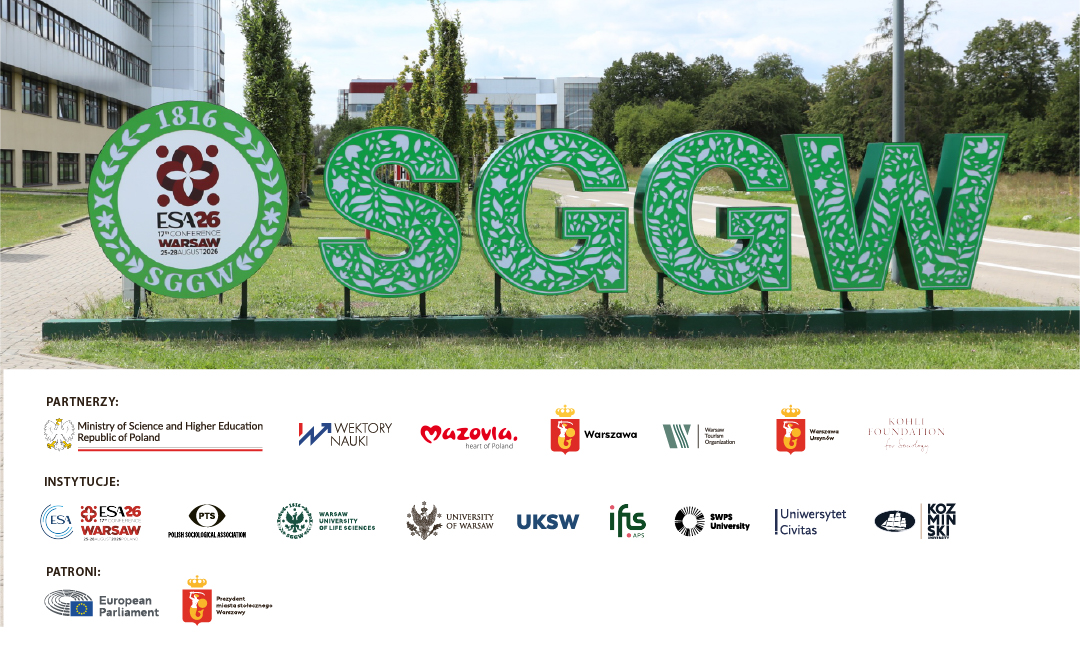
The ESA conference is being held in Warsaw for the first time and in Poland for the second time, following the conference organised in Toruń in 2005. The organisers of the 17th ESA Conference are Warsaw’s sociological institutions and universities: the Polish Sociological Association, Warsaw University of Life Sciences – SGGW, University of Warsaw, Cardinal Stefan Wyszyński University, Institute of Philosophy and Sociology of the Maria Grzegorzewska University, SWPS University, Civitas University, and Kozminski University.
The two days of the conference taking place at SGGW will also give international participants an opportunity to discover the University, its campus, academic community, and traditions.
One of the highlights of the programme will be a concert by Promni Jazz Quintet. The performance will present Polish musical influences in a contemporary jazz setting while also drawing on the traditions and cultural heritage associated with SGGW. The inclusion of Promni Jazz Quintet in the event programme will offer international guests an opportunity to experience a distinctive element of the University’s academic identity – the combination of tradition with contemporary culture and openness to new forms of artistic expression.
17th Conference of the European Sociological Association
25–28 August 2026, Warsaw
26–27 August 2026 – Main scientific programme at the SGGW campus, 166 Nowoursynowska Street
SGGW Researchers in the Programme of the 17th ESA Conference
The following SGGW researchers will present their work as part of the conference’s scientific programme:
- Rafał Boguszewski – “Determinants and Consequences of Poles’ Withdrawal from Religious Practice in the Context of the COVID-19 Pandemic”, session “Changes of Religious Belonging and Constellations of Religious Actors”. Rafał Boguszewski will also chair this session.
- Konrad Burdyka – “The Rural Shield: Traditional NGOs at the Frontline of Social Resilience in Poland”, session “Institutions and Rural Futures”.
- Jolanta Grotowska-Leder – “Declining Fertility as a Result of Post-modern Risks and the Creation of New Threats in Key Spheres of Individual and Social Life. The Case of Poland”, session “Everyday Risk, Social Change and Life Trajectories”.
- Małgorzata Herudzińska – “Determinants and Consequences of Poles’ Withdrawal from Religious Practice in the Context of the COVID-19 Pandemic”, session “Changes of Religious Belonging and Constellations of Religious Actors”.
- Agnieszka Kampka – “Communication Practices in Democracy – Participation in the City”, session “Practices of Urban Engagements”.
- Wojciech Połeć – “Problems of Renaissance and Institutionalization of the Ethnic Belief System in Contemporary Societies. The Case of Buryat Shamanism”, session “Transformations of Religious Institutions”.
- Urszula Soler – “Human–Machine Collaboration in Trustworthy Biometrics: Social Dimensions of Technological Supervision”, session “Trust, Ethics and Human-AI Relations”.
- Bartosz Łukaszewski – “Polish Youth in the Algorithmic, Multidimensional and Multipolar World – Anxiety, Subjective General Health, Development Opportunities”, session “Children and Youth in Transformation: Methodological and Contextual Challenges”.
- Michał Wujek – “From Education to Employment: A Psychocybernetic Model of University–Socio-Economic Cooperation”, session “Crises”.
- Joanna Wyleżałek – “From Education to Employment: A Psychocybernetic Model of University–Socio-Economic Cooperation”, session “Crises”.
SGGW Doctoral Researchers
- Dominika Dziurosz-Serafinowicz – “Where Does a Lie Lie?”, session “(Non)understanding in Interaction”.
- Wiktoria Ługowska – “Conscious Creators or Passive Users? A Systematic Literature Review on Youth Digital Literacy in the Process of Building Peer Relationships”, session “Youth, Peer Relationships and Social Cohesion”.