

Meeting with a Nobel Prize Laureate at SGGW
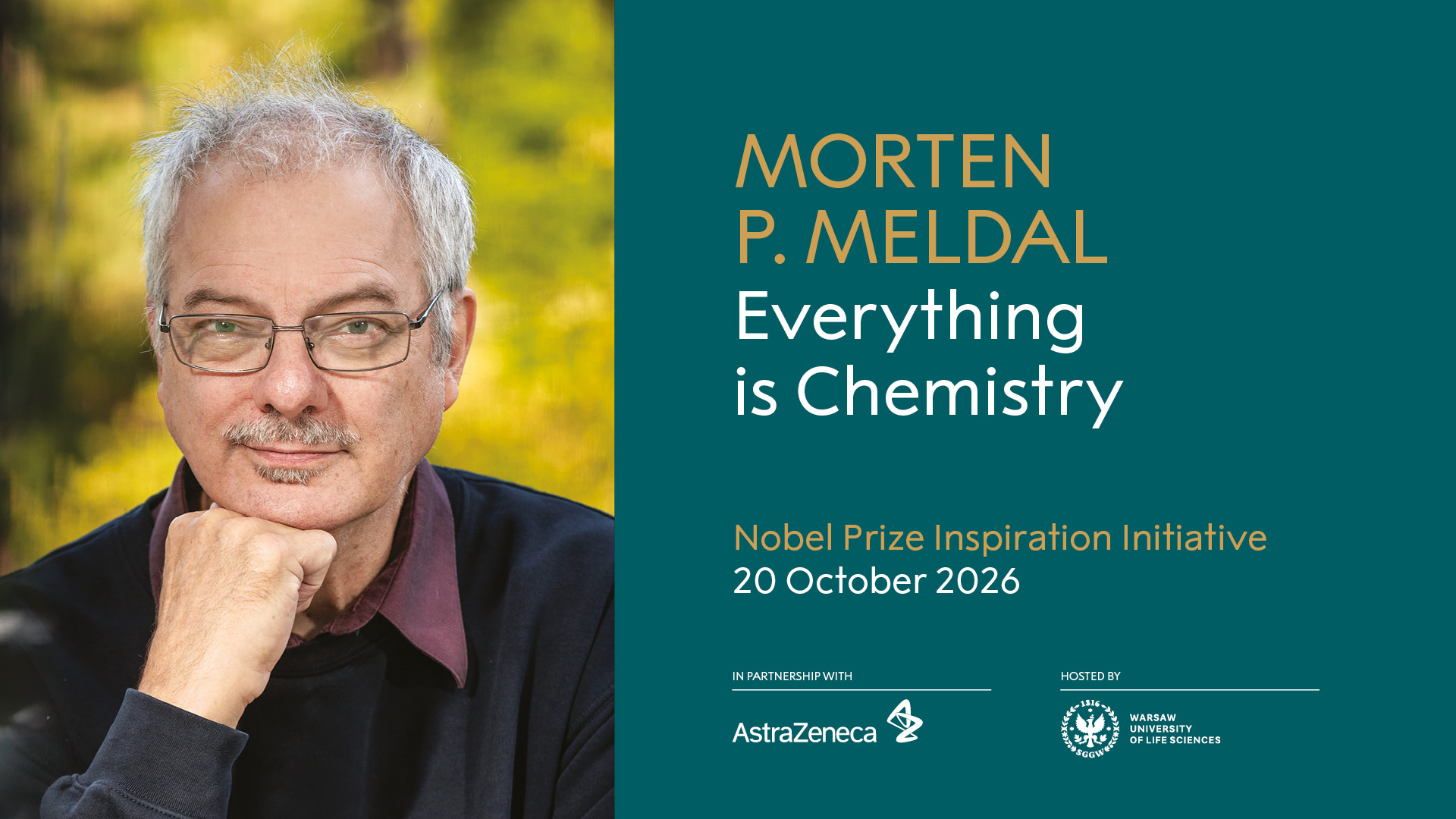
The Warsaw University of Life Sciences will host an exceptional scientific event. On October 20, we will welcome Professor Morten P. Meldal, Nobel Prize laureate in Chemistry.
Morten Meldal, Professor at Center for Evolutionary Chemical Biology (CECB), Department of Chemistry, University of Copenhagen, head of Center for Evolutionary Chemical Biology (CECB) since 2013. From 2011 to 2013 he headed the Nano Science Center, University of Copenhagen. He has been the leader of the synthesis group at the Carlsberg Laboratory 1988-2011, and was appointed as full professor there in 2004.
He was also appointed as Adj. Professor at the Technical University of Denmark in 1996 and in 2004 at University of Copenhagen. Professor Morten Meldal has a degree in engineering and a technical Ph.D. degree in the synthetic chemistry of oligosaccharides. From 1983-1988 he worked as independent research associate in organic chemistry at The Technical University of Denmark and University of Copenhagen. In 1985-1986 he was a postdoctoral research associate at Medical Research Council Center, Laboratory of Molecular Biology, UK.
He was the 1996 winner of the NKT Research Award for Chemistry, the recipient of the 1996 Leonidas Zervas Award from the European Peptide Society and in 1997 he received the Ellen and Niels Bjerrum Gold Medal in chemistry. In 2009 he received the Ralph F. Hirschmann ACS-award in peptide chemistry. In 2022 he received the Nobel Prize in Chemistry.
The Meldal-group has published more than 350 publications and reviews in international journals and filed 29 patents describing work in many different areas of organic and bioorganic chemistry. The CECB research group combines technology and research across many scientific disciplines within a combinatorial chemistry platform. The structure of CECB provides technology for the study of complex mechanisms in molecular recognition and biochemical processing from a chemical point of view.
The research at CECB aims at understanding molecular recognition, signaling and processing. Typical topics are GPCR-signaling, enzyme and catalyst processing, molecular recognition for controlling cell behavior. The research at CECB is therefore at the interface between chemistry, biology and material sciences. CECB has developed a range of platform technologies to facilitate the study of recognition, processing and signaling. On-bead assays performed on custom made biocompatible PEG-resins include solid phase FRET protease substrate assays, a cells-on-bead assay for investigation of GPCR-activation, a molecular adhesion assay. Combinatorial chemistry is facilitated by optical bead encoding technology, fluorescence activated bead sorting and high resolution mass spectrometry.
The Nobel Prize Inspiration Initiative
The event is being organized as part of The Nobel Prize Inspiration Initiative, an international program run by Nobel Prize Outreach in collaboration with AstraZeneca. The initiative aims to inspire young scientists and foster connections within the academic community through direct meetings with Nobel Prize laureates.
We warmly invite you to join us for this special event. It is a unique opportunity to meet an outstanding scientist, hear about his journey to the Nobel Prize, and gain insight into the research that is shaping the future of modern medicine.
The event will also feature Dr. Phaedria Marie St. Hilaire, a scientist and advocate for women in STEM (Science, Technology, Engineering and Mathematics). She is the founder of ProWoC (Professional Women of Colour Network) in Denmark, an organization that supports women in their professional development.
Collaboration between the Faculty of Biology and Biotechnology and AstraZeneca
The meeting with Professor Morten P. Meldal, Nobel Prize laureate, is made possible through the close collaboration between the Faculty of Biology and Biotechnology and AstraZeneca, the organizer of the event. The Faculty’s partnership with the company is an example of building strong relationships between the academic community, the global scientific community, and the innovative biomedical technology sector.
The event will be held in English.
Places are limited.